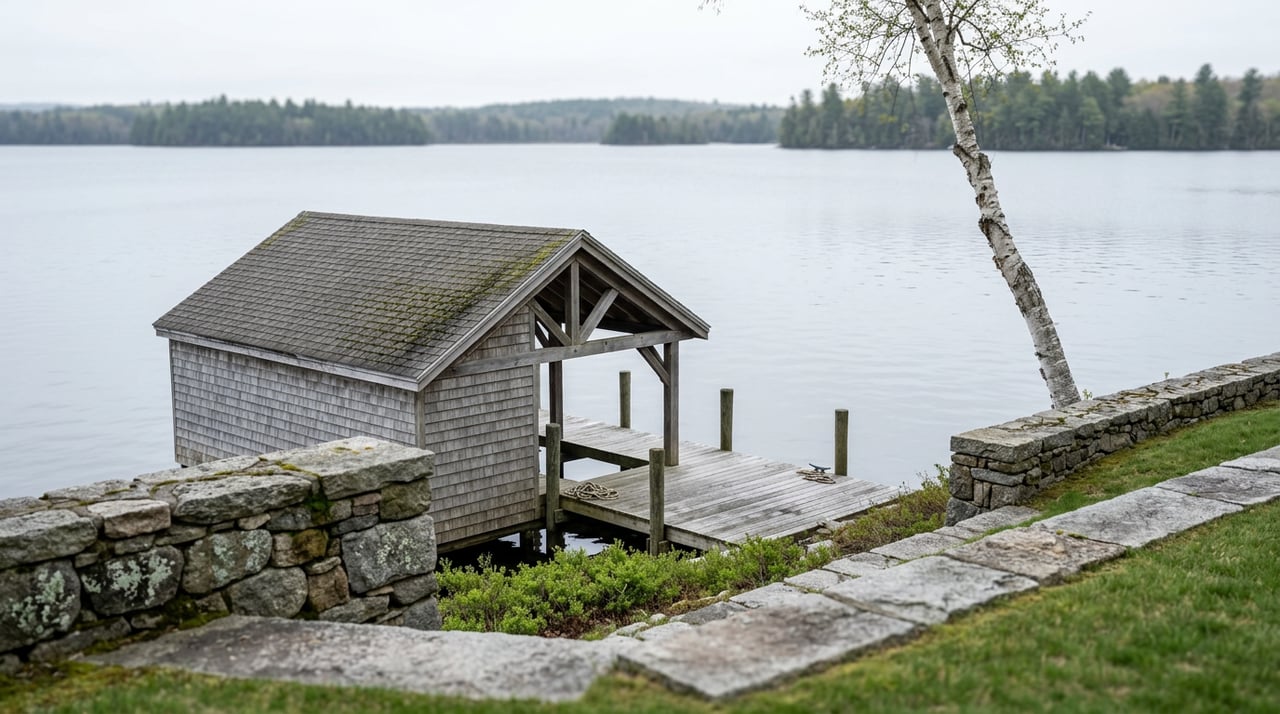
What happens to a boathouse built in 1925 once the rules that govern docks get written decades later, and rewritten again after that?
That question sits quietly inside a listing description that's currently circulating for a Smith Cove property on Lake Winnipesaukee: 61 feet of level, west-facing shoreline, protected no-wake water, easy access to the Broads, and a "grandfathered 1925 laker-style boathouse" presented as one of the property's defining features. Most buyers read that line as charm. It's actually a legal status, and legal statuses have conditions attached.
In Gilford, the number of boat slips a shorefront property is allowed to carry has nothing to do with the price, the view, or how the listing photos are cropped. It's arithmetic, and the arithmetic was written into New Hampshire wetlands rules long after most of Gilford's older camps and boathouses were built. That mismatch between when a dock was constructed and when the counting rule was written is the actual story behind every "existing infrastructure already in place" line you'll see on a Winnipesaukee listing this fall.
The Formula Behind the Photos
New Hampshire's Wetlands Bureau caps private, non-commercial docking on Lake Winnipesaukee using a frontage-based formula under Rule Env-Wt 402.12, known informally as the 75-foot rule. The first 75 feet of a property's average shoreline frontage earns two boat slips. Every additional 75 feet of frontage adds one more slip. It's a simple ratio, but it's the ratio that decides whether a property can legally support a runabout and a pontoon, or a runabout, a pontoon, and a guest's boat too.
Two real permit filings from Gilford show the math working exactly as written. A property with an average of 212 feet of frontage along Lake Winnipesaukee in Gilford was capped at three slips under Env-Wt 513.12, according to a New Hampshire Governor's Council agenda filed in January 2026. A separate filing from June 2025 covering a Governor's Island property in Gilford, with 450 feet of average frontage, allowed a maximum of seven slips, and the proposed project asked for six.
Laid out across a range of frontage measurements, the formula looks like this:
| Average Shoreline Frontage | Maximum Boat Slips (Env-Wt 402.12) |
|---|---|
| 75 ft | 2 |
| 150 ft | 3 |
| 212 ft (confirmed, Gilford permit filing, Jan. 2026) | 3 |
| 225 ft | 4 |
| 300 ft | 5 |
| 375 ft | 6 |
| 450 ft (confirmed, Governor's Island, Gilford) | 7 |
Run that Smith Cove listing's 61 feet of frontage through the same formula, and it lands under the 75-foot threshold entirely. That's not a criticism of the property. It's the reason "grandfathered" appears in the description at all. Whatever docking capacity that 1925 boathouse actually provides, a buyer starting from scratch today, at 61 feet of frontage, could not newly permit anything beyond the baseline the rule allows. The existing structure is worth something precisely because current rules would not recreate it.
The Clause That Makes It Temporary
Here's the part that doesn't make it into most listing copy. The same NHDES filings that set slip counts also carry a condition that limits how long a grandfathered advantage survives contact with a transaction. Any subdivision of a property's shoreline frontage triggers a requirement to remove enough of the existing docking structure to bring it back into compliance with the density rules in effect at the time the subdivision happens, not the rules in effect when the dock was built.
That single condition changes how a buyer should think about any Gilford waterfront parcel with more dock capacity than its current frontage would newly permit. A family camp with a legacy boathouse and several decades of informal additions might be carrying more slips than the frontage technically supports today. Divide that parcel among heirs, sell off a back lot, or split a compound into two conveyances, and the rule requires the excess to come down, regardless of how long it's been standing. The same filings note that owners of permanent docking structures that aren't kept structurally sound also have an obligation to remove them. A grandfathered dock isn't a permanent exemption. It's a status that holds only as long as the frontage stays whole and the structure stays maintained.
Repair Versus Rebuild: The Distinction That Decides Everything
Not every fix to an old dock reopens the current-rules question. New Hampshire's permitting process draws a sharp line between repair and reconfiguration, and which side of that line a project falls on determines whether a grandfathered dock keeps its legacy status or gets measured against today's formula.
Above-the-waterline maintenance, like replacing deck boards or repairing a stringer, generally doesn't require a permit at all, as long as there's no change in the structure's size, location, or configuration. Anything involving in-water work, including pile driving, dredging, boat lifts, or new personal watercraft lifts, falls under Wetlands Bureau jurisdiction and needs a permit path, even for repairs.
Simple, low-impact projects can move through a Permit by Notification, a streamlined process where NHDES doesn't issue a formal permit but instead accepts the filing after a 10 or 21-day review window. Slightly larger projects fall under a Minimum Impact Permit, reviewed over 30 days and requiring local Conservation Commission sign-off before it reaches the state. Anything bigger, like the Governor's Island project that rebuilt retaining walls, expanded a perched beach, and reconstructed two piling docks, moves through a standard or major permit review, with public notice and site visits built in.
That Governor's Island filing is worth a second look for what it reveals about strategy. The western dock was rebuilt "in kind," meaning it kept its existing footprint and configuration exactly, which is how an owner preserves a grandfathered structure through a repair rather than losing it to a reconfiguration. The eastern dock, by contrast, was rebuilt in a new shape and size, which meant it had to meet current standards rather than legacy ones. Same property, same permit application, two different outcomes, because the paperwork treated them as two different kinds of project.
What This Means Before You Write an Offer
Gilford's waterfront segment isn't a market where buyers get to sort out permit questions after signing a purchase agreement. As of early September 2026, waterfront homes in Gilford carried a median list price near $645,000, spent roughly 54 days on the market, and typically drew several competing offers. That pace doesn't leave room to discover mid-contract that a dock's slip count doesn't match its permit history.
Before submitting an offer on any Gilford waterfront property, ask for the dock's permit history and file number from the NHDES Wetlands Bureau and the Town of Gilford's building and planning office. Confirm whether the current dock configuration is legal, grandfathered, or unpermitted, because title, lending, and insurance can all hinge on that distinction. If the listing frontage is close to a formula threshold, run the math yourself rather than assuming the existing structure reflects what today's rule would allow. And if a parcel might get subdivided down the road, whether between family members or as part of a future sale, factor in that the subdivision itself can force a reduction in dock capacity, independent of anything the buyer does wrong.
An Alternative for Buyers Priced Out of the Frontage Math
Not every Gilford buyer needs to own shoreline to reach the water. Boat slips at Mountain View Yacht Club are deeded and sold separately from any home, giving buyers direct access to the Broads without the frontage calculations that come with owning shorefront footage outright. For residents who want a public option instead, Gilford's own Glendale Docks, located at 31 Dock Road next to the town's Marine Patrol Headquarters, offer boat ramps and dock space exclusively to Gilford residents and taxpayers under a permit required from April 1 through October 31, with the busiest stretch falling between Memorial Day and Labor Day.
A Few Questions Worth Asking Before You Tour
Can I add a dock to a Gilford property that doesn't currently have one? Yes, but the frontage formula still applies, and any new in-water structure requires a permit from NHDES, along with local zoning approval from the Town of Gilford. Start with a licensed surveyor to establish the property's average frontage before assuming what's possible.
Does a grandfathered dock make a property more valuable? Often, because it can carry more capacity than current rules would newly allow. That value comes with the condition attached: it holds only as long as the frontage isn't subdivided and the structure is kept in sound, usable condition.
What if I want to split a larger waterfront lot between family members later? Run the numbers before you plan the split. NHDES rules require dock structures to be brought into compliance with the density rules in effect at the time of subdivision, which can mean losing slips a family has used for decades.
Dock rights are one of the few parts of a Gilford waterfront purchase that can't be renegotiated after closing. If you're weighing a shorefront property and want to understand what its frontage actually entitles you to before you write an offer, Lake Mountain Property Group can help you start your lake property search with that math already worked out.